Science and Reliigon on Purpose: purpose may be a continuing issue since scientists often say the only purpose we have exists in our heads or hopes, not in the world. Religion counters that the cosmos itself is shaped by purpose and, in turn, gives purpose to our lives.
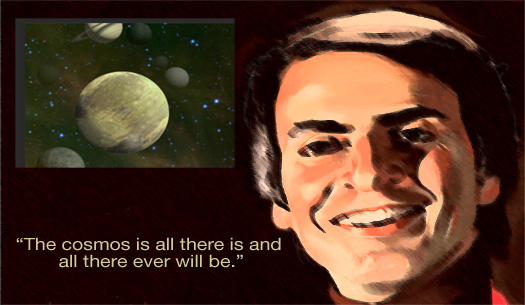
Purposeless Cosmos: Carl Sagan's 1980 book and PBS program brandished an image of science devoid of teleological questions. After science dropped such questions, he argues, it became dramatically more successful--there is no reason to return to such unproductive questions.
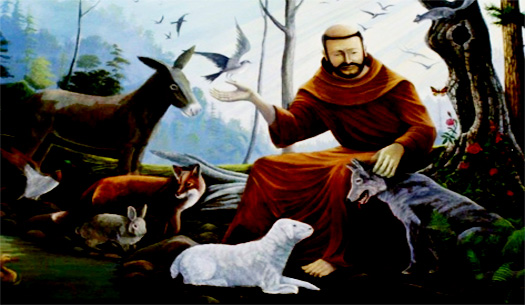
St. Francis' Religion of Nature. Embracing teleology, St. Francis saw purpose everywhere, especially among the animals and plants that he believed intuited the divine presence enough to sing the Creator's praises. The "Canticle of Creation" is the high point of medieval natural religion.
Is Religion Ecologically Aware? Haught agrees that religious people have sometimes ingnored the growing ecological crisis owing to their beliefs. He argues that ecological responsibility is entailed by viewing the world as divinely created such that we are its stewards.
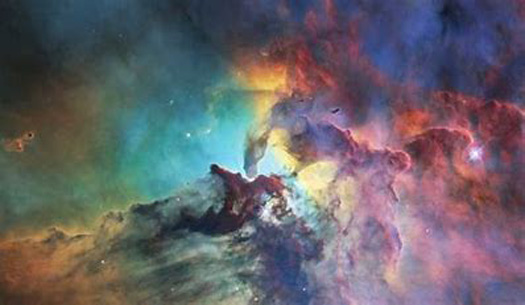
Hubble Beauty: The Hubble telescope has done more than any recent technology to impress us of the scope and extraodinary beauty of the universe. Both science and religion can now agree it is an expanding, beautiful cosmos that leaves us speechless. It is more than a massive, uncaring machine.
Buddha Nature: Buddhism is famous for its doctrine of non-attachment, but it is misunderstood. One school argues it is a matter of not imposing our views and goals on nature, but welcoming nature's wisdom and insight so that we become better people and care for it intensely, hence ecological awareness.
Slide Show:Purpose and Nature
Mouseover the thumbnail images for slide show.
Do the slide show and video before reading the Introduction.
We Must Create Our Purpose
Carl Sagan narrated the first "Cosmos," and was a champion of science without religion. 1. What are telescopes and why? 2. We project our own nature onto what? 3. Darwin wrote that we were created by what? 4. We are from "m and m"--what is it and what does it mean in terms of purpose?
1. Time machines because the light they capture originated long ago.
2. We project our nature onto nature and assume it must be like us or made for us.
3. Other animals.
4. "Microbes and muck." This is what it means to deny teleology.
Larry's Introduction to Ch. 8-9: Purpose and Ecology
The big question is at last addressed: do our lives have any significance in a universe so vast and so old our lives can be compared to ants marching along a 8-lane interstate highway? Some trees live fifty times as long as we do (admittedly, not much social life).
Does Teleology (Purpose) Matter?
You will recall the idea of materialism--the real is the material and any other kinds of experiences or things we seem to experience are reducible to matter. Most of Haught's book leads to this question: whether the universe has any purpose and cares anything about you. Remember the Rabbi in New York who commented, "I believe the universe is a massive, uncaring machine. Get over it."
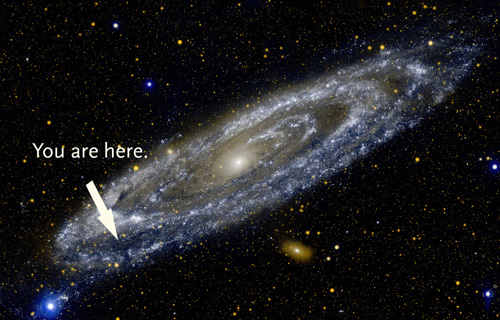
>Vast Universe: First picture is where our solar system is in the Milkey Way galaxy--yes you live in the border country. Second piacture is North America pictured against Jupiter, which is massive compared to Earth.
The late Harvard biologist Steven JayGould claimed that a purposeless universe still "exciting," so we will have to invent a purpose which it does not itself possess.
Haught poses the significant problem of teleology:
I and the world constitute an inseparable unity, so that if the cosmos as a whole has no purpose to it, then surely this says something about who I am. ... if there is after all a teleological dimension to the universe it too would enter into the definition of my own being.
If the universe has no purpose, then, neither does human life and the hope that we can invent a purpose for the universe is forlorn:
(1) we know from science how tied our lives are with physical reality and its history--"the whole is deeply determinative of our own identities."
(2) if the universe is without purpose, how do we avoid the conclusion our lives are without purpose?
(3) the "God religions" (Judaism, Christianity, Islam) argue the universe, as a creation, does have a purpose.
In golf, if there were no greens, no flags marking the goal, just people aimlessly hitting golf balls around, would it have a purpose?
Challenge: Is the scientific view of a cosmos without teleology analogous to hitting a golf ball on a course with no greens, no flags, and no cups?
Some scientists such as Weinberg would say yes since "the more we know about the universe the more pointless it seems to be."
Others would say while the universe has no purpose we can identify our lives can have plenty of purpose, without religion, and that is all we need.
But if the universe is pointless, in the final analysis, can our lives have a point?
Should Science or Religion Should Engage in Teleology?
deGrasse Tyson on Purpose of the Universe (3 min.)
The controversy over religion and science comes down to whether science is not just compatible with religion but whether it is compatible with the idea that behind all the phenomena science studies and attempts to explain, it is defensible to believe there is a Cosmic Person.
(1)Conflict: science was held captive by theology before the "scientific revolution," which dropped teleology from science's question--that's when the scientists made such astonishing progress. Questions of purpose are counter-productive for science. As Weinberg suggested, the less we talk about teleology, the better scientific understanding we can achieve.
(2)Contrast: the Conflict view presupposes materialism and there are good grounds to flag materialism as a philosophy, not part of science. We "cosmic pessimists." Science should avoid talk of final causes, but other disciplines and traditions can help us understand purpose.
(3)Contact: the Contrasters draw too sharp a line between science and religion, mechanisms studied by science and what purposes there might be. Close scrutiny of sciences leaves us with questions about purpose that science cannot answer. So we need dialogue between religion and science. In the aim toward increasing beauty we see how cosmology accords with religion.
(4)Confirmation: Human attempts to spell out the purpose of the universe are "best left shrouded in silence." Religion cautions us not to claim more than we can possibly know--much of religious practice is non-verbal deference to transcendent person who is infinitely wiser than us. So there is a parallel between science and religion which it comes to large teleological questions.
Challenge: Which of Haught's four views, perhaps surprisingly, is deGrasse Tyson's take one whether the universe has purpose?
We might assume that deGrasse Tyson is purely of the Conflict view. While he winds up concluding that it is difficult to find a purpose, and lots of evidence it does not, he has fair amount in common with the Confirmation view since it emphasizes silence in the face of questions that cannot be answered.
So he mostly endorses the Conflict view, as we would expect, but has a fair amount of sympathy for the Confirmation view.
Religion and Environmental Responsibility
Victoria Gill "Nun Teaching Scientists" (14 min)
St. Francis' "Canticle of Creation" (4 min)
1. Victoria Gill is a science reporter for the BBC. What is her view of the contribution religion can make to science (watch 8 minutes)?
As a science reporter for the BBC, she of course has a high regard for science. But science is more than theories, it is on-the-ground knowledge of ecosystems which sometimes local people--such as a community of nuns--know more about than scientists. A group of nuns is helping save a critical species.
If you see the world as a creation, you believe it to be sacred and worth getting to know.
2.What is the humility problem that impairs scientists, according to Gill, especially with regard to working with non-scientists and people with little formal education (at about 7 minutes)?
Is "local knowledge" still knowledge?
Only in the last century or so has science become the domain of professional scientists. Darwin was a "gentleman scientist" who worked largely at home. Mendel was a monk in a monastery.
But contemporary science is done by professors and research scientists at large research laboratories and they are not inclined to find nuns or fishermen or indigenous people scientifically pertinent.
Yet Gill argues that these are the people on the ground with lots of local knowledge that science should recognize as critical. That includes nuns and Buddhists meditating in the mountains.
1. Consider these lyrics:
Be praised, my Lord, for Sister Earth, our Mother, who nourishes and sustains us.
How is this an ecological prayer?
Francis was immersed in nature and saw it as a Creation, such that the Creation itself would sing praises to the Creator. The Creation is Sacred and worthy of our care.
2. How is it that St. Francis can even praise death (at the end of the Canticle, but not sung here)?
Be praised, my Lord, for our Sister Death,
whom we must all face.
I praise and bless you, Lord,
and I give thanks to you,
and I will serve you in all humility.
Responsible environmentalists view death to be just as much a part of nature as life. Our approaching deaths reminds us that we need the humility cited by Haught as important to both religion and science.
St. Francis' celebration of death is either completely deranged or absolutely remarkable and worth our thought.
Haught concedes at the outset that religious people have the reputation, partly deserved, of being unconcerned about the environment and the current degredation of the oceans, air and land. If you believe the world is likely to end soon, you might not be concerned to save the snail darter, a small fish.
But that is a minor strain of religious belief. Particularly in the "God-religions," God is creator, the world is the created, and believers take the world to be a gift from God worth maintaining.
On the other hand, religious institutions have sometimes seemed to ignore the ecological crisis. Haught quotes one writer to the effect that the lack of religious concern for the planet "has been nothing less than extraordinary."
The Four Views of Religion and Environmental Responsibility
(1)Conflict: religion at best a distraction from the pursuit of science as a completely secular research program. This view grants that religion can bring some moral fervor to environmental responsibility, but religionists have too often supposed a deity will take responsibility for the world's care when we are the only responsible persons.
(2)Contrast: the Bible encourages stewardship of God's creation so that fact that some religionists have been environmentally irresponsible simply means they are not practicing their religion well. Religious humility should be recognized by the scientific community as useful to aiding an appropriate scientific humility. It is unfair to blame the crisis on religious belief.
A good basis for environmental responsibility stems from the religious conviction that the Earth and its splendors participates in the eternally true.
(3)Contact: the Contrasters are too busy defending a mistaken understanding of religion's responsibility for the crisis they fail to note the positive contribution religion has made. An environmental responsibility ethic "demands that put our roots down deeply into nature."
(4)Confirmation: Human attempts to spell out the purpose of the universe are "best left shrouded in silence." Religion cautions us not to claim more than we can possibly know--much of religious practice is non-verbal deference to transcendent person who is infinitely wiser than us. So there is a parallel between science and religion which it comes to large teleological questions.
Haught Questions and Explorations
Part 1
1. Haught writes that educated people today often question whether they can believe in "the ancient religious intuition that the cosmos is an embodiment of transcendent meaning" (163). Why does he believe that modern people can have such a belief but that newer science is more compatible with it?
Around 1850, most scientists believed the universe was in a steady state, that species are fixed and systems are largely static. Now science believes the universe began in a "big bang," there is a remarkable history to species development, and that dynamism characterizes most systems such as you, economics, and ecosystems. Haught argues this is more compatible with theism and the idea of an active God who continues to create.
2. Would deGrasse Tyson be impressed by St. Francis' natural religion, with its celebration of ecosystems, life and death?
Finally no, since St. Francis saw teleology everywhere and as essential to human welfare. DeGrasse Tyson would argue that science began to be really helpful to people when it abandoned Aristotle's teleological philosophy in favor of materialistic science.
Musical Cosmos (4 minutes)
3. Sagan espouses scientific humility in the face of the complexity and vastness of the universe but what is Gill's complaint about the hubris of professional science?
She suggests that professional science sometimes falls prey to the fallacy that if it is known, it must be known by professional scientists. She defends the view there is lots of local knowledge, especially in terms of local ecosystems and histories, that scientists would do well to acknowledge.
4. Exploration: The Hubble Spacecraft has given a much fuller view of the beauty of the universe and it has its own music--please view the view at right which celebrates that beauty.
If the cosmos is beautiful, are there implications for whether we have purpose?
If we lived in a horribly ugly universe, that would seem to count against the idea of a divine creator. But we live in a strikingly beautiful universe. We have much more appreciation for the beauty of the universe than was true not long ago. Haught would argue this counts in favor of a transcendent Person who endows our lives with beauty and therefore purpose.
5. The Contact view argues that this (one word answer) is the most promising point of contact between science and theology in terms of initiating and sustaining a productive conversation. Why does this make sense?
Beauty. That is, the beauty of the cosmos and its ongoing evolution/creation. Aesthetics plays a large role in evaluating scientific theories and is important in religion which attempts to cultivate aesthetic awareness in practitioners.
That's why the double helix structure of DNA, at left, is beautiful, not unlike some buildings set aside for religious observance, such as the mosque at right.
6. Challenge: How does Haught in the Contact view argue that the "God-religions" and science seem to be converging again after a century or so of estrangement (174-5). Do you think the public at large understands this newer development (also related to your paper)?
Haught sees convergence between science and religion in terms of not only beauty but trust in an emerging but predictableuniverse, that the cosmos even seems to have a narrative, a story, not unlike the religious traditions.
This is perhaps Haught's most insightful paragraph on the relation of science and religion:
...we cannot help noticing the results of evolutionary biology, particle and relativity physics, astonomy, and chaos theory--major ingredients of the new cosmology--can be meaningfully contextualized by the story of promise and hope through which the Abrahamic religious tradition has already shaped our way of looking at the world (175).
This claim is not well understood by either mass media or popular culture, which often see continuing conflict, a view that was never quite true.
Part 2
1. Explain Confirmation's claim that religion and science, properly understood, share a commitment to quiet, humble work (181). How does it "liberate" the human mind so it finds "its proper groove." Are you convinced?
More recent science back away from pursuit of theories capable of predicting the future behavior of complex adaptive systems such as you, the economy, the ecosystem and the universe at large. The idea that scientific theories are useful but not confirmable as true has led many philosophers of science to suggest that science cannot give us a true, exact understanding the world. We must be more humble.
2. Important: Since all three of the "God religions" have had apocalpytic strains (our next book is Apocalpytic AI), is there some truth to the claim that religion is often less environmentally concerned (183-4) since it is tempted to leave such matters to God.
If we believe the world is going to end next Tuesday, we probably won't be concerned to drive less or moderate our air conditioning and sometimes religious people have imagined environmental responsibility is something God will take care of. In fact, the Jewish concept of the messiah helped give rise to Christianity.
But as described in this last chapter, there is a growing awarenss that religous people, people of the covenant, are responsible for being good stewards of the creation.
3. Exploration: What is the "irresolvable dilemma" that Contact view attempts to dispel (191)? How can science help us through the dilemma?
1. How does he define non-attachment in a way consistent with what Haught is urging?
He wants us to be alive to what is happening in the world, but not in terms of manipulating it for our ends (which would be attachment). Non-attachment does not mean non-engagement, but non-manipulative engagement.
2. What does non-attachment mean in terms of ideas we might have?
Not clinging to ideas so that we are resistant to new ideas. Attachment, Stone argues, is trying to own ideas so they serve our purposes. Non-attachment, paradoxically, is openness to the world that takes it in its own terms, not ours.
Non-attachment is non-controlling, open engagement with the world. Haught would see this as a good way to environmental responsibility while embracing faith.
Non-attachment is engagement at a level underneath language and concepts. It is deep engagement with the world directly but non-manipulatively.
Some religious teachings urge us to roam homelessly without attaching to the world (Buddhism in particular warns against attachment to other people). At the same time an "ecological ethic" urges us to attach the world in a deep way so we care for it.
Haught points out that science teaches that nature is restless, not static, not eternal. Instead the world is a work in progress, just as we should be.
Please do the video in the sidebar at right and answer the questions.
4. How important is time in this account in terms of how we understand the world?What is eschatology?
It is not a static world, both science and religion now agree. It had a spectacular beginning, then unfolded over eons of time into the astonishingly beautiful cosmos that we see.
The universe is not eternal; it will come to an end. Eschatology is the study of end things, what kind of consummation the universe will take.
So interestingly, both science and religion have a somwhat similar view of time: the universe begin, evolves over time, and will come an end.
5. What are some of the new dimensions of more recent cosmology that assist us in being environmentally aware (192-193)? How does mind come back into the story?
Haught argues that new ideas in physics have brought mind back into the story that physics tells about how we perceive the world. In the past, mind has often been dismissed as something produced by matter but not essential to it.
Here is the pivotal comment:
... we humans cast a long subjective shadow over the primary qualities ... that we used to think were objectively the same [for everyone]. We cannot extricate our minds from nature ... to have an absolute perspective on things. ... mind is much more deeply embedded in the physical universe that we had suspected (193).
6. What lies at the "heart of nature, on the Contact view (195)?
How is this related to environmental responsibility?
The heart of nature is "promise" (195). Haught argues the beauty of the world is such that we have to draw the conclusion that it must be sustained by us, on the promise of a Creator who wants us to recognize that beauty and maintain it as faithful stewards. So hope and promise are intimately related, so that we don't abandon our call to be stewards of a creation, not just a universe.




 1. Time machines because the light they capture originated long ago.
 Haught poses the significant problem of
 Some scientists such as Weinberg would say yes since "the more we know about the universe the more pointless it seems to be."
 We might assume that deGrasse Tyson is purely of the Conflict view. While he winds up concluding that it is difficult to find a purpose, and lots of evidence it does not, he has fair amount in common with the Confirmation view since it emphasizes silence in the face of questions that cannot be answered.
  What is the humility problem that impairs scientists, according to Gill, especially with regard to working with non-scientists and people with little formal education (at about 7 minutes)?


 But that is a minor strain of religious belief. Particularly in the "God-religions," God is creator, the world is the created, and believers take the world to be a gift from God worth maintaining.
 4.
4. 

 If we believe the world is going to end next Tuesday, we probably won't be concerned to drive less or moderate our air conditioning and sometimes religious people have imagined environmental responsibility is something God will take care of. In fact, the Jewish concept of the
  1. How does he define non-attachment in a way consistent with what Haught is urging?
 It is not a static world, both science and religion now agree. It had a spectacular beginning, then unfolded over eons of time into the astonishingly beautiful cosmos that we see.
 ... we humans cast a long subjective shadow over the primary qualities ... that we used to think were objectively the same [for everyone]. We cannot extricate our minds from nature ... to have an absolute perspective on things. ... mind is much more deeply embedded in the physical universe that we had suspected (193).